Log In
Is the UX job market oversaturated? An in-depth analysis and outlook for 2024
If you’re considering becoming a UX designer, you may be concerned about job market saturation. With ongoing tech layoffs, hiring freezes, and a notable downturn in UX job postings, it certainly feels like UX is perhaps no longer the secure career path it was five or ten years ago.
But what’s the reality?
We looked up the latest market data and hiring trends, and spoke to Eoghain Cooper, Career Advisor and Recruiting Specialist at UX Design Institute, to find out what’s going on in the UX job market right now—and how it’s impacting entry-level UX designers in particular. We’ve compiled all the most useful insights into this article, divided into two parts: The UX job market outlook for 2024, and practical advice for entry-level designers.
Has the UX job market reached saturation point? (The short answer)
The short answer to this question is no—the UX job market has not reached the point of oversaturation.
The industry is changing and evolving (when is it not?) and the UX job market isn’t what it was two or three years ago. We have seen a downturn in UX job postings in recent years, for reasons we’ll go into shortly. Despite this, UX designers are still in demand—and there’s still a notable deficit of skilled UX professionals. As you can see, the topic is a bit more nuanced than a simple yes or no. With that, let’s take a closer look at what’s really going on.
Why does it feel like the UX job market is saturated? What’s driving this misconception?
A lot is happening in the UX industry right now, and it’s not surprising that UX designers might feel like they’re on shaky ground—especially entry-level ones. There are several key factors contributing to a general feeling of uncertainty in the job market:
- Large-scale (and ongoing) layoffs in the traditional tech sector
- A significant downturn in UX job postings
- The rise of AI
All pretty scary on the surface—but decidedly less so if you dig a little deeper. With that, let’s explore the reality behind the headlines.
UX job postings have decreased significantly in recent years—what’s going on? The numbers don’t lie—but perspective is everything.
If you’ve been keeping an eye on UX job openings, you’ve probably noticed that there’s been quite a drop. From 2022 to 2023, job site Indeed reported a 73% decrease in UX research job postings. UX designer job openings were down 71%.
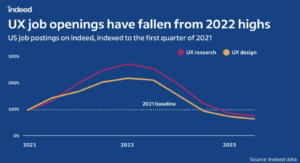
The numbers don’t lie—but perspective is everything. Remember how the hiring frenzy during the pandemic years (2020-2022) turned out to be unsustainable and unrealistic in the long term? It makes sense, then, that UX job postings would drop to more normal levels in 2023 and beyond. Even more reassuring is the longer-term trend of job growth before the pandemic. If you compare UX research job openings in 2023 to those in 2018, you’ll notice a 53% increase over those 5 years. Not bad! Likewise, while a 71% drop in UX design openings from 2022-2023 seems shocking, that’s only a 23% decrease from 2018-2023. The longer-term trajectory is considerably less worrying and speaks to the natural maturation of the UX industry.
In short: UX design job openings may be down compared to a few years back, but the demand for skilled UX designers is not. As Eoghain puts it: There are still fewer UX jobs than there were at the end of 2022— I’m not going to pretend there hasn’t been a downturn. But ultimately there is still a deficit of qualified and highly qualified individuals.
The rise of artificial intelligence—will AI replace UX designers?
It’s impossible to talk about job security without mentioning AI. Perhaps one of the most frequently asked questions since ChatGPT and similar entered the mainstream is: Will AI replace UX designers? A legitimate concern, but not a reality that seems likely to materialise any time soon (if ever). So what’s the situation here? AI is replacing certain jobs—PwC estimates that up to 30% of jobs could be automated by 2030—but it’s also creating new ones. The World Economic Forumpredicts that, by 2025, AI will have opened up 97 million new (human) jobs.
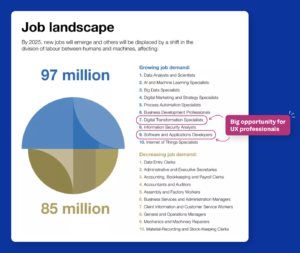
As for UX specifically, AI is already streamlining certain aspects of the UX design process. Many designers are now using AI tools to help with user research, content design, and general day-to-day tasks. But, given that UX is fundamentally a human-centric field that relies just as much on emotional intelligence and empathy as it does on data and analytics, there’s no likely scenario where AI could fully replace human designers. The rise of AI is more of an opportunity than a threat. UX designers can work faster and more efficiently—leaving more room for strategy and creative thinking. Exciting times! For further insights on the topic, check out this interview with Nick Babich, Principal UX Designer at Brain Technologies, exploring how AI will impact UX designers in both the short and long term.
Are UX designers still in demand? 3 major growth sectors for UX jobs
Overall UX job growth has slowed in recent years, especially within the tech sector. However, while typically UX-heavy industries are starting to plateau, we’re seeing an interesting shift in other industries that haven’t traditionally focused on UX. Eoghain Cooper specialises in helping entry-level UX designers land their first job, and he notes three sectors in particular that are investing heavily in UX right now:
- The finance industry
- The medical tech sector
- Government and civil service
So what’s driving the UX boom in these sectors?
Ultimately, a more pressing need than ever to adapt, modernise, and provide a first-class user experience.
UX job growth in the finance industry
In finance, legacy banks are now competing with challenger banks like Revolut, N26, and Monzo. If they want to keep up, they need to level up in terms of the digital experience they provide—and that, of course, requires skilled UX designers. The NatWest Group, for example, invested $2.3 billion in their digital transformation strategy in 2022, while JPMorgan and Morgan Stanley are both building new UX divisions to support their digitisation efforts. These are just a handful of examples of the rise of UX in finance.
The rise of UX in the medical sector
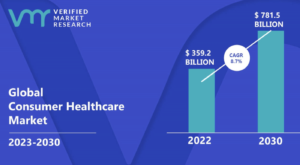
The medical sector is also undergoing intense digitisation, driving a greater need for UX designers. The global consumer healthcare market is projected to reach $781.5 billion by 2030—and, most significantly for UX, the Internet of Medical Things (IoMT) market is projected to reach $187.6 billion by 2028 (compared to $13.23 billion in 2020). There’s a rapidly growing demand for digital healthcare solutions—and for people who can design them and ensure they’re accessible and usable.
How can entry-level UX designers stand out and increase their chances of getting hired?
The UX job market is competitive—and, as we covered in part one of this report, there’s an abundance of entry-level hopefuls coming from UX bootcamps and courses.
So how can you cut through the noise and prove your value?
Career Advisor and Recruiting Specialist Eoghain Cooper offers 5 key pieces of advice that have proven crucial in helping his graduates land jobs:
- Pay attention to the quality of your portfolio
- Strategically leverage your previous experience
- Showcase success metrics
- Take a targeted approach to your job search
- Optimise your resume for ATS (Applicant Tracking Systems)
Let’s explore each strategy in more detail.
1. Pay attention to the quality of your portfolio
Your UX design portfolio is your first real opportunity to show hiring managers what you’re capable of. Eoghain emphasises the importance of quality over quantity here: you don’t need loads of projects—one or two is enough to get your foot in the door, as long as they’re well thought-out and communicated.
And, while you’re often advised to showcase your design process, Eoghain explains that it’s much more impactful to showcase the results of your process.
“Often, when starting their portfolio, junior designers will explain what they did, step-by-step, without actually highlighting the impact of their work. However, hiring managers don’t necessarily need to see affinity diagrams—they need to see what key insights you took from them and how you utilised them.
For example, I would usually recommend that someone highlight their research strategy and explain why they’ve chosen particular methods and how that supports the project. I also want to see the key results that came from that, and how those were balanced against business considerations—not just the needs of the end user. From there, I want to see what decisions they made and the impact of those decisions. A hiring manager is going to be looking for results and impact.”
Learn more: What do hiring managers look for in a UX portfolio?
2. Strategically leverage your previous experience
You might be new to UX, but you’re not an entirely blank canvas. Every candidate brings their own unique experiences and perspectives to the field, no matter what background they’re coming from.
If you want to stand out from the crowd, you must strategically leverage your previous experience and highlight your transferable skills.
Eoghain explains:
Often, people don’t actually see their value or identify existing skills that will be useful for UX—or they don’t know how to frame it. For new UX designers, though, it’s essential to highlight your transferable skills.
“If you’ve got a background in psychology, for example, and have conducted clinical research, that’s a perfect opportunity to highlight your strong methodological research skills. Even seemingly unrelated areas have lots of crossovers. We’ve had a lot of people come from customer service backgrounds—in which case, I encourage them to emphasise their ability to empathise with end users, ask appropriate questions, and solve key customer problems.”
3. Showcase success metrics
Related to the topic of leveraging your previous experience, Eoghain also advises sharing success metrics from your previous role(s).
Even if you’re coming from another industry—say, marketing—it’s well worth showcasing tangible performance metrics or data that demonstrate your success in that role.
This shows that you’re capable of working to a particular standard. As Eoghain puts it: performance is transferable. If you can apply yourself and perform in one industry, you can just as well apply yourself and perform in a new industry like UX—and hiring managers will see the value in that.
4. Take a targeted approach to your job search
In terms of finding suitable jobs, Eoghain strongly advises taking a targeted approach.
Focus on specific companies within industries you’re interested in and research what the company is all about and the values they stand for. Then customise your application accordingly.
With a highly tailored application, you’re showing the hiring manager that you’re genuinely interested in their company. This indicates that you’re more likely to stick around long-term—so they know that their investment in you is time and money well spent.
5. Optimise your resume for ATS (Applicant Tracking Systems)
Finally, Eoghain notes that many companies are now using Applicant Tracking Systems to vet candidates and screen their applications. This is an automatic process, so the system will be looking for keywords and phrases that appear in the job description.
To increase your chances of getting through the ATS, identify key terms in the job description and incorporate them (naturally) into your resume. This approach will help you pass through the technology and get to have a conversation with a human!
Source: UX Design Institute